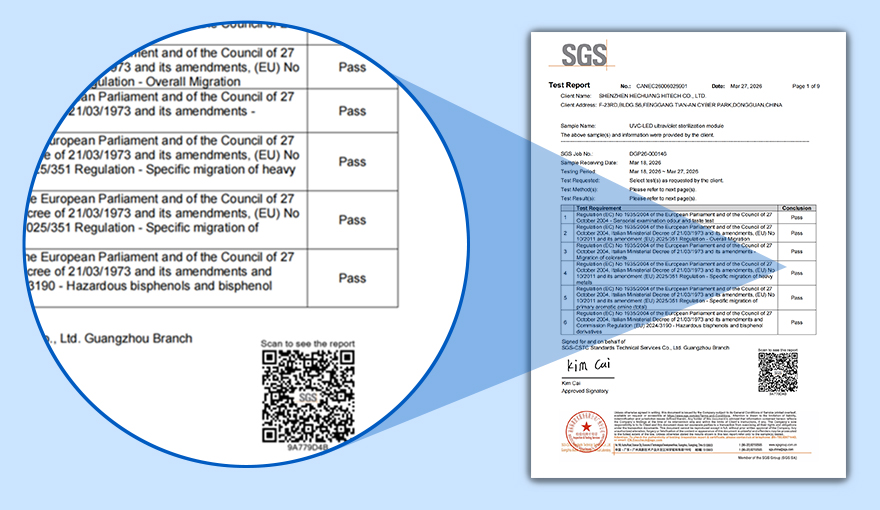

With increasing environmental regulations, the production of ozone has become a significant concern for many consumers. So, does UVC-LED light chip packaging produce ozone? Let’s take a closer look.
UVC LED chips emit ultraviolet light with a wavelength typically between 260 to 280nm, which is specifically used for sterilization and disinfection. This range of ultraviolet light can effectively disrupt the DNA or RNA structure of bacteria and viruses, which is why UVC LED technology is widely used in air purifiers, drinking water systems, surface disinfection, and even medical devices.
But how is ozone generated? Ozone is typically produced when ultraviolet light with a wavelength lower than 240nm interacts with oxygen (O₂) in the air. The higher-energy ultraviolet light breaks apart oxygen molecules, causing them to recombine into ozone (O₃). Therefore, ultraviolet light below 240nm generates ozone.
However, most UVC LEDs on the market have wavelengths in the range of 265nm, 275nm, and 278nm, which are well above 240nm. As a result, under normal usage conditions, they almost never produce ozone.
That being said, not all UVC lights are free from ozone production. For example, traditional mercury-based UV lamps typically emit light in the 200nm to 280nm range, which includes the 185nm wavelength that produces ozone. As such, mercury lamps often have a noticeable ozone odor. The glass UV lamps once commonly used in laboratories, for instance, would produce a distinct ozone smell after being turned on for a while.
For consumers, if you are using UVC LED chips with a wavelength range between 260-280nm, you can generally be assured that ozone production is not a concern. However, if a UVC light claims to both sterilize and deodorize while producing ozone, it is likely emitting light at a lower wavelength and may not be suitable for prolonged use in indoor spaces.
From a technical standpoint, one of the key advantages of UVC LEDs over traditional mercury lamps is their eco-friendliness, safety, and absence of ozone. UVC LEDs are compact, energy-efficient, have a long lifespan, and contain no mercury, making them much more environmentally and health-friendly. Under normal wavelengths, UVC LED chips almost never produce ozone, unless they are specially designed with a wavelength below 240nm.
In our years of experience, we have worked with hundreds of different UVC LED chip packages. In practical use, the only instances in which ozone is noticeable are typically with non-LED sources or products with unclear wavelength specifications.
Therefore, when choosing and designing UVC products, we recommend opting for UVC LED chips in the 265nm, 275nm wavelength range. These options are safe, ozone-free, and more reliable for everyday use.
For more information on UV water sterilization technology and our products, please visit our website or contact our customer service team directly. We look forward to providing you with the best water treatment solutions to ensure your water safety.
For more information, inquiries or to book an interview please Contact:
Shenzhen Hechuang Hitech CO., LTD.
info@hc-hitech.com
Toll Free +86-769 8208 2301 / +86-769 8208 2380