
As awareness of drinking water safety and public health continues to grow, UVC-LED water disinfection technology is being increasingly adopted across residential, commercial, and professional applications. In real-world use, UVC-LED water disinfection generally falls into two categories: static water disinfection and dynamic water disinfection. These two approaches differ significantly in their working principles, application scenarios, and technical requirements.
Static water disinfection refers to a process in which water is disinfected under stationary or low-flow conditions using UVC-LED light. In this mode, water is typically stored in a tank, container, or chamber and exposed to UVC light for an extended period, allowing microorganisms to be inactivated through damage to their DNA or RNA structures.
Key characteristics and application areas include:
Relatively longer disinfection time
Simpler system design
Commonly used in:
Water storage tanks
Laboratory water systems
Medical or industrial static water treatment environments
Static disinfection is well suited for applications where flow rate is not critical and longer treatment times are acceptable.
Dynamic water disinfection, by contrast, occurs while water is continuously flowing through a disinfection chamber. As the water passes through the system, it is exposed to high-intensity UVC-LED light for an extremely short duration, achieving rapid and efficient microbial inactivation.
Key technical requirements include:
High-power, highly stable UVC-LED light sources
Precisely engineered optical and hydraulic designs
Accurate control of flow rate, UV dose, and exposure time
Typical application areas include:
Residential and commercial drinking water systems
Instant water dispensers
Point-of-use disinfection in water purifiers
Outdoor, RV, and marine water systems
Medical and high-standard water treatment applications
The most significant advantage of dynamic water disinfection is instant availability—safe water is delivered immediately, without the need for waiting.

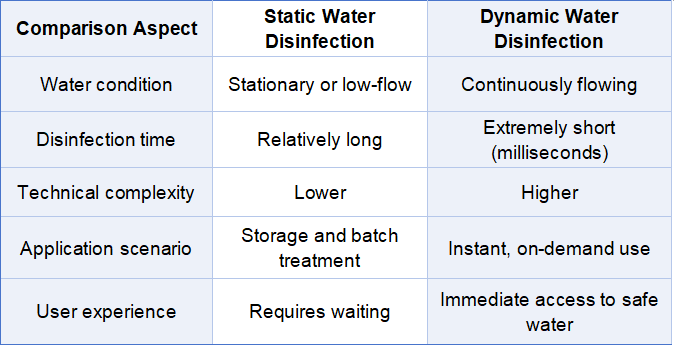
Dynamic water disinfection places significantly higher demands on system design, stability, and overall technical maturity.
Innest has long focused on the development and application of UVC-LED dynamic water disinfection technology, building a mature and reliable technical framework centered on high efficiency, ultra-fast response, and long-term system stability.
Innest’s UVC-LED dynamic water disinfection modules are capable of eliminating bacteria and viruses within just 0.2 seconds, delivering high disinfection performance while maintaining consistent and safe operation across a wide range of water use scenarios.
Both static and dynamic water disinfection methods play important roles in their respective fields. However, as demand for instant and on-demand safe drinking water continues to rise, dynamic UVC-LED water disinfection is becoming a key direction for the industry’s future.
Innest remains committed to advancing dynamic water disinfection technology and welcomes partners, customers, and industry professionals to consult, exchange ideas, and explore collaboration opportunities together.
For more information, inquiries or to book an interview please Contact:
Shenzhen Hechuang Hitech CO., LTD.
info@hc-hitech.com
Toll Free +86-769 8208 2301 / +86-769 8208 2380